
Kruger Shalati Retains Two MICHELIN Keys for 2026
Once Is Remarkable. Twice Says Something More. In 2025, Kruger Shalati: The Train on the Bridge was awarded Two MICHELIN Keys in the MICHELIN Guide’s first hotel selection…



Understanding Kruger National Park weather is the first step to planning a safari that matches what you want from your trip. The park sits in South Africa’s summer rainfall region, which means its year divides cleanly into two seasons rather than four: a hot, wet Green Season and a cooler, dry Golden Season. Each shapes the landscape, the wildlife and the light in a different way – and at Kruger Shalati, perched on the Selati Bridge above the Sabie River, that seasonal shift is part of the experience itself, not just a backdrop to it.
Whether you’re chasing the driest possible game drive or the greenest possible photograph, knowing what each month brings will help you choose your travel dates with confidence.
Kruger National Park has a subtropical climate with two distinct seasons: a dry winter from May to October and a wet, hot summer from November to April. Winter days are mild and sunny with cold nights, while summer brings heat, humidity and dramatic afternoon thunderstorms.
Because rainfall is concentrated in summer, dry-season vegetation thins out considerably, concentrating animals around rivers and waterholes – including the Sabie River below Kruger Shalati. Wet-season vegetation, by contrast, turns the bushveld a deep green and coincides with the arrival of newborn antelope, migratory birds and dramatic summer skies.

Hot and humid, with average daytime temperatures around 30–33°C and the year’s heaviest rainfall. Afternoon thunderstorms are common; the bush is thick and green, and impala lambs and other newborns are everywhere.
Similar to January – warm, wet and lush – though rainfall typically begins to ease slightly. Excellent for birders, as many migratory species are still present in full breeding plumage.
Still warm (high 20s to low 30s°C) with decreasing rainfall as the season transitions. Vegetation remains dense, but game viewing starts to improve as the bush slowly thins.
A genuine shoulder month: daytime temperatures settle into the mid-to-high 20s°C, rain becomes less frequent, and the landscape is at its most photogenic – still green, but increasingly easy to see into. As summer’s wildflowers begin to fade, their dying blooms are the bushveld’s own signal that the dry season is on its way.
The unofficial start of the dry season. Days are pleasant (low-to-mid 20s°C), nights turn cold, and rainfall drops away almost entirely. Vegetation continues to thin, improving sightlines along the Sabie River.
Kruger’s coolest month. Daytime highs sit around 20–23°C, with early-morning game drives requiring a warm layer as temperatures can dip toward single digits before sunrise.
Dry, clear and cold at night (often 5–9°C before dawn), warming to a comfortable 22–24°C by midday. Animals concentrate reliably around remaining water sources, making this a favourite month for game viewing.
Warming slightly, with daytime temperatures around 24–26°C. Vegetation is at its sparsest, visibility is excellent, and this remains prime season for spotting predators along open riverbanks.
Hot, dry and dusty, with temperatures climbing into the high 20s°C. Considered one of the best all-round months for game viewing, as animals cluster tightly around dwindling water.
The hottest dry-season month, often exceeding 30°C, with the first hints of pre-rain humidity building. Wildlife sightings remain strong even as the first storms of the new season begin to gather.
The Green Season begins in earnest. Rain returns, temperatures hover in the high 20s to low 30s°C, and the bush starts its rapid transformation from gold to green.
Hot, humid and green, with regular afternoon storms and average highs around 31–32°C. Newborn wildlife continues to arrive, wildflowers come into full bloom across the bushveld, and the Sabie River typically runs fuller than at any point in the dry season.

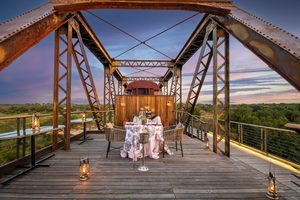
Few places make Kruger’s seasonal rhythm as visible as Kruger Shalati. Suspended on the Selati Bridge above the Sabie River, the property offers a front-row view of the river’s transformation – from a slow, exposed ribbon of water in the dry-season months, drawing wildlife to its banks in full view of the train, to a fuller, faster current once the summer rains arrive.
Golden-season light (roughly May to August) tends to favour photographers, with clear skies, low humidity, and dust in the air that softens sunrise and sunset into hazy, diffused tones across the riverbed. Those same clear, largely cloudless winter nights make for some of the best stargazing of the year from the bridge. Green-season evenings (November to April), by contrast, bring dramatic cloud formations and lightning over the bridge – a spectacular backdrop from a private Juliet balcony or the carriage lounge. Whichever season you choose, the story of the Selati Bridge adds context to the view.
Malaria risk in the Kruger region is present year-round but generally low, rising during the warmer, wetter months of November to April when mosquito activity increases. It drops significantly during the cooler, drier winter months.
Standard precautions apply regardless of season: covering up between dusk and dawn, using insect repellent, and discussing antimalarial medication with a travel health professional before your trip. All Kruger Shalati accommodation is appropriately screened and netted, and further official guidance is available directly from SANParks’ malaria advisory.

There isn’t a single “best” month – it depends on what you’re travelling for. This comparison reflects how Kruger National Park weather patterns line up with different priorities:
| What You’re After | Best Months | Why |
|---|---|---|
| Prime game viewing | May–September | Thin vegetation and low water levels concentrate wildlife along rivers and waterholes |
| Photography & golden light | May–August | Clear, dry air and soft low-angle light, with minimal midday haze |
| Newborn wildlife & birdlife | November–March | Calving season overlaps with the arrival of migratory bird species |
| Dramatic scenery & fewer midweek crowds | November–February | Lush green landscapes and striking summer storm systems |
If you’re not sure where your own trip fits, our team can help you plan the best time for your Kruger Shalati stay around exactly what you want to see.
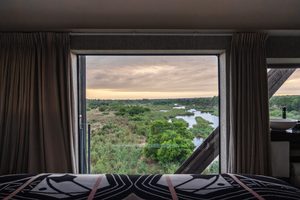
Whatever the month, our floor-to-ceiling suites are designed to keep you comfortable while keeping the bushveld – and the bridge below – always in view.
What is the rainy season in Kruger National Park? Kruger’s rainy season, often called the Green Season, runs from November to April. Rain typically falls in short, intense afternoon thunderstorms rather than all-day downpours, and the bush becomes noticeably lusher through this period.
What is the dry season in Kruger National Park? The dry season runs from May to October, with negligible rainfall, thinning vegetation and progressively lower water levels. It’s widely regarded as the most reliable period for consistent game viewing.
Is Kruger National Park hot in summer? Yes. Summer (November to March) is hot and humid, with daytime temperatures regularly reaching the low 30s°C and high humidity, especially in the lead-up to afternoon storms.
Does it get cold in Kruger National Park in winter? Winter days are mild, typically 20–25°C, but early mornings and nights can drop to single digits, especially in June and July. Warm layers for morning and evening game drives are essential.
When is the best time to see newborn animals in Kruger? Most antelope and many other species give birth between November and February, when abundant rain produces the fresh grazing needed to support young. This period also coincides with the arrival of many migratory bird species.
Is malaria a risk all year in Kruger National Park? Malaria risk exists throughout the year but is low overall and highest during the warmer, wetter months of November to April. Standard precautions – repellent, appropriate clothing and, where advised, antimalarial medication – are recommended regardless of season.

However you like your safari – bone-dry and predictable, or green, dramatic and full of new life – Kruger National Park’s weather offers a compelling reason to visit in almost any month. The clearest sightlines tend to fall between May and September, while November to April rewards patience with lush scenery, dramatic skies and a bushveld in the middle of raising its next generation.
Wherever your dates fall, Kruger Shalati offers a vantage point unlike any other in the park: suspended above the Sabie River, watching the seasons move beneath you. Reserve your carriage at Kruger Shalati and start planning your stay around the Kruger National Park weather that suits you best.
Once Is Remarkable. Twice Says Something More. In 2025, Kruger Shalati: The Train on the Bridge was awarded Two MICHELIN Keys in the MICHELIN Guide’s first hotel selection…
Key Takeaways A safari honeymoon in South Africa pairs privacy, romance and shared adventure in a way few other trips can match. A truly honeymoon-worthy experience is built…
Key Takeaways A luxury South Africa safari is defined by expert guiding, design-led lodges and considered service, not simply a high price tag; Kruger Shalati holds Two MICHELIN…



Kruger Shalati
the Train on the Bridge
Selati Station & Bridge
Skukuza Rest Camp
Kruger National Park